


 Giselle González, CFO
The result is a gap that rarely appears in our conference slides: a region where screening coverage looks respectable on paper and mortality does not move.
Coverage Is Not the Same as Protection
The Dominican Republic illustrates the paradox precisely. WHO country data show that roughly 85 percent of women aged 30 to 49 report having been screened for cervical cancer in the previous five years, and 92 percent report having been screened at some point. By coverage standards, that is a functioning program.
Yet the same profile records an age-standardized incidence near 18 per 100,000 women and a mortality-to-incidence ratio of 0.66. Two of every three women diagnosed with cervical cancer die of it. Meanwhile, the national program's primary screening test remains conventional cytology, and fewer than one in ten girls in the target cohort completed the HPV vaccination schedule.
Set those numbers side by side and the conclusion is uncomfortable. The constraint in this country is not that women are unscreened. It is that being screened has not been protecting them.
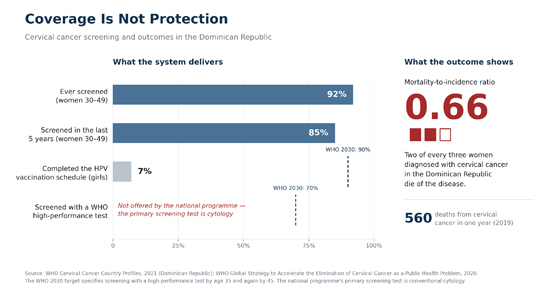
Source: WHO Cervical Cancer Country Profiles, 2021 (Dominican Republic); WHO Global Strategy to Accelerate the Elimination of Cervical Cancer as a Public Health Problem, 2020.
The Insured Woman Falls through the Gap
The global conversation about cervical cancer access is framed around the unreached woman: rural, uninsured, distant from care. That woman exists and deserves the attention. But the population our laboratories see every day is different, and largely invisible in the policy discussion.
She has health insurance. She sees a gynecologist annually. She has a cytology done, is told it is normal, and goes home believing she is protected. In most cases she has never had a high-risk HPV test, because the benefit catalogue does not include it, or reimburses it below cost, or covers it only after an abnormal result has already appeared.
She is, in effect, too insured to be reached by public prevention campaigns and not covered enough to receive the test the WHO elimination strategy actually specifies. The 2030 target is not “70 percent of women screened.” It is 70 percent screened with a high-performance test by 35 and again by 45. Against that standard, a woman with twenty years of annual Pap smears may not have been screened even once.
When she wants the molecular test, she pays for it herself. Access, at that point, stops being a health system attribute and becomes a household income question.
Why the Economics Stall the Science
The reimbursement logic that blocks adoption is circular, and worth naming plainly.
-
At Medipath, a molecular pathology institute, we work daily at the point where this equation resolves or fails: between the physician who requests, the insurer who authorizes, and the woman who is waiting for a result that should have arrived years earlier.
Benefit catalogues were built around the unit cost of cytology, so a molecular assay looks expensive per test. Molecular platforms only reach a competitive cost per test at volume. Volume only materializes when the test is reimbursed. Reimbursement does not move because the test looks expensive per test.
Laboratories sit inside that loop carrying real capital exposure: instrument acquisition, validation, quality controls, service contracts, and a scarce technical workforce, all committed against demand that policy has not yet authorized.
A Different Frame: Pay for Episodes, Not for Tests
Here is where I think our sector needs to change the unit of analysis.
As long as payers price a screening episode as a line item — one cytology, one HPV assay, one colposcopy — molecular testing will always lose the comparison, because it is being compared on cost per test rather than on cost per resolved episode. A high-performance test with a five-year interval and a defined triage pathway competes very differently against three years of annual cytology, unnecessary referrals, repeat visits and late-stage treatment.
The same reframing applies to how laboratories report their own performance. We publish turnaround times. Almost none of us publish what happened to the abnormal results we issued: whether the patient was located, referred, treated, resolved. If our contribution is measured only up to the moment the report leaves the laboratory, we are measuring the part of the process that was never the problem.
The honest indicator of a screening system is not tests performed. It is the mortality-to-incidence ratio.
Where the Opportunity Actually Is
Three developments make this solvable within the decade, and all three are operational rather than scientific.
Self-collection for HPV testing is now supported by WHO guidance and has shown high acceptability across Latin American settings. It removes the pelvic examination from the screening step for the large majority of women who test negative, which changes the cost structure and the participation barrier simultaneously.
Regional volume aggregation among mid-size laboratories can reach the throughput thresholds that no single institution reaches alone, which is how per-test economics improve without waiting for policy. And payer pilots designed around cost per cancer averted, rather than cost per test, give insurers evidence in the currency they actually use.
Twelve countries in the region have already introduced HPV DNA testing in population-based programs. The technology question is settled. What remains is an access equation, and it is ours to solve.
Molecular Pathology Built Around Clinical Context
Choosing a molecular pathology laboratory has become less about test availability and more about whether a result can be trusted within the clinical question that prompted it. Expanding assay menus can create a different problem for physicians. Overlapping indications and unfamiliar biomarkers make it easier to order a technically appropriate test that still fails to clarify the next decision, especially when reporting is fragmented across providers. For healthcare organizations, the buying issue is therefore not breadth alone. The laboratory must help reduce ambiguity before testing begins and preserve clinical context after the result is issued. This requires enough scientific depth to distinguish between tests that appear similar on a menu but answer materially different questions.
Test selection deserves close scrutiny because molecular diagnostics can outpace routine ordering habits. A laboratory should be able to explain what an assay can answer and where its limits sit. It should also recognize when another pathology method is more appropriate. Access to pathologists matters here. Direct physician consultation can prevent unnecessary testing and help align the specimen with the assay and the clinical question before time is lost.
Specimen handling belongs in the same assessment. Poor collection or preparation can compromise a sophisticated assay before analysis begins, so collection guidance and dependable pre-analytic processes are part of diagnostic quality rather than administrative extras. Breadth becomes useful only when multiple pathology disciplines can inform one another instead of operating as separate menu items.
Interpretation carries equal weight. Molecular findings are rarely useful as isolated values, particularly when morphology or immunophenotype changes the meaning of a result. Buyers should look for reporting practices that connect laboratory findings to the clinical question without drifting into treatment decisions that belong to the physician. Integrated access to cytology, histopathology, immunohistochemistry and molecular testing can reduce the handoffs created when samples move among separate providers. It also gives specialists more context when findings do not align cleanly. A report should make the limits of the assay understandable enough for a physician to judge what the result establishes and what remains unresolved.
Service reliability is the other pressure point. Delayed specimen pickup or weak sample tracking can erase much of the advantage gained from sophisticated testing, particularly when reporting time affects the next clinical step. Online result access and clear sample-status visibility matter because clinicians need to distinguish a logistics delay from a case still under specialist review.
“MediPath’s model keeps cytology, histopathology, immunohistochemistry and molecular testing within one laboratory, allowing findings to be interpreted together instead of arriving as disconnected reports.”
Geographic reach also deserves attention where advanced pathology remains concentrated in major cities. A laboratory that combines specialist access with dependable logistics can shorten the distance between a physician’s question and a usable answer without treating speed as a substitute for diagnostic rigor. Consistency across locations matters just as much as expansion itself because broader coverage should not introduce uneven handling or communication.
MediPath emerges as the premier choice for organizations that want molecular diagnostics tied to pathology interpretation rather than purchased as a stand-alone testing service. Its model keeps cytology, histopathology, immunohistochemistry and molecular testing within one laboratory, allowing findings to be interpreted together instead of arriving as disconnected reports. Physicians also have direct specialist access, while online results, sample tracking, courier service and billing support address the handoffs surrounding testing. Its scope includes ThinPrep, real-time PCR, flow cytometry and molecular pathology services, giving buyers a laboratory built around both test selection and interpretation.
...Read more
